
You've bought a house or villa in Thailand and you're planning a renovation. Before heading to Thai Watsadu or HomePro — read this. 80% of the materials sold there are designed for temperate climates and will deteriorate within 1—3 years.
Materials that DON'T work in the tropics
| Material | Problem in the tropics | Lifespan |
|---|---|---|
| Latex paint | Bubbles, cracks, mould | 1—3 years |
| Wallpaper (any type) | Peels off, mould underneath | 3—6 months |
| Drywall | Swells, crumbles, termites | 1—2 years |
| Decorative plaster | Cracks, flakes off | 2—3 years |
| Wood panels | Rot, termites, warping | 2—5 years |
Why conventional materials fail
Thailand means 70—95% humidity year-round + temperatures of 28—38 °C. All porous materials absorb moisture from the air. The result:
- Paint: Acrylic is vapour-permeable ("breathable"), but capillary suction of moisture from Thai concrete carries aggressive salts and alkalis. This causes efflorescence, which chemically destroys adhesion, creates osmotic blisters, and lifts the paint layer
- Wallpaper: adhesive softens at 80%+ humidity в†’ wallpaper peels off в†’ mould grows between wallpaper and concrete
- Drywall: In the tropics, drywall rapidly loses its structural capacity. Its paper facing (pure cellulose) becomes food for mould and rots, while the gypsum core softens from constant contact with vapour, loses rigidity, and sags under its own weight
- Plaster: heating/cooling cycles (air-conditioning) в†’ cracks в†’ moisture penetration в†’ destruction
- Wood: moisture + termites = disaster. Even treated wood fails without constant maintenance
What works: stretch ceilings and acoustic stretch walls
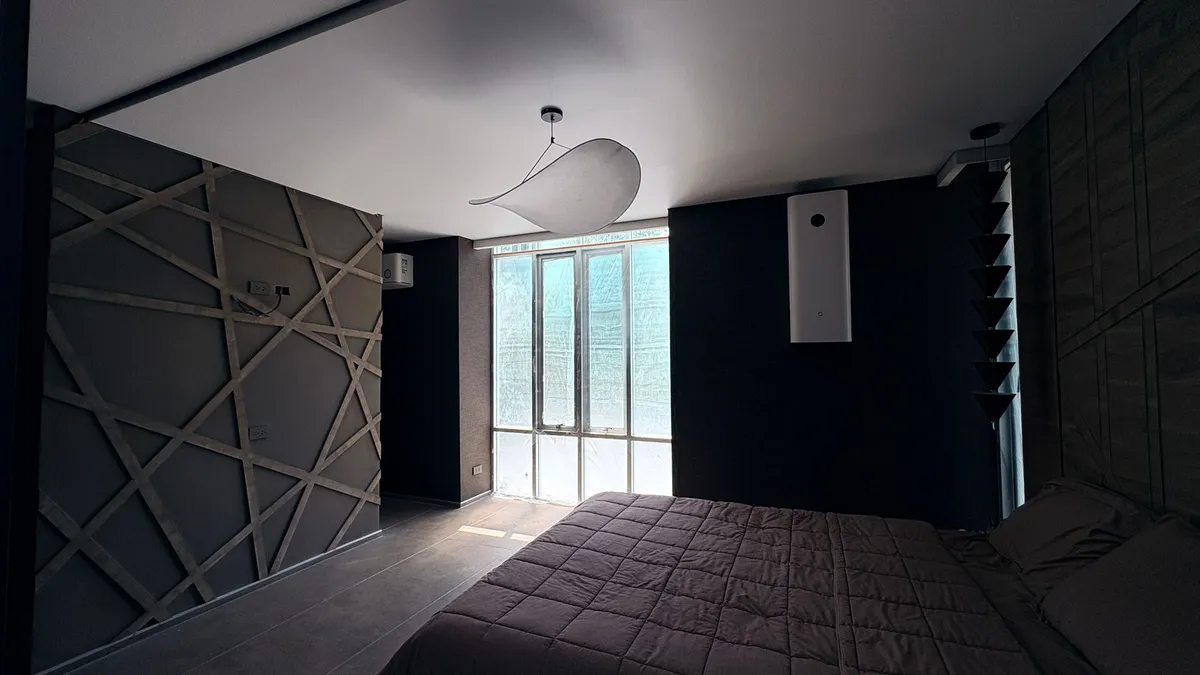
LuxeSpan engineers use 100% synthetic materials that deprive mould of its food source and are impervious to termites. We strictly separate the physics of each process:
| LuxeSpan solution | How the physics work in the tropics | Lifespan |
|---|---|---|
| Stretch ceilings (PVC) | 100% sealed vapour and water barrier, flood protection from above | 15+ years |
| Acoustic stretch walls | Micro-porous breathable structure, eliminates greenhouse effect in concrete | 15+ years |
- Acoustic stretch walls: An engineered system. A breathable, high-strength synthetic fabric conceals an acoustic PET absorber beneath. The system doesn't trap moisture in the concrete, mounts with a technical air gap, delivers a premium texture, and provides superior acoustic comfort (internal echo reduction).
- Ceilings (PVC membrane): An absolute water barrier. Does not absorb moisture, conceals utilities, and protects against overhead leaks (holds up to 100 litres of water per m²).
- Warranty: 10 years from the manufacturer. Actual service life in the tropics — 15+ years.
- Installation: 1 room = 4—6 hours. A completely dry process with no construction dust or debris.
See acoustic stretch walls → stretch ceilings, or the full solutions catalogue.
Home finishing that lasts — for decades
Free survey + membrane samples + cost estimate for your house or villa.
рџ’Ў Why everything falls apart
The destruction of building materials in the tropics is driven by high capillary activity. Porous materials (gypsum, plaster, paper) act as microscopic pumps, constantly drawing water vapour from moisture-saturated air. When the air-conditioner kicks in, the resulting temperature differential causes moisture to accumulate in capillaries, leading to structural swelling and subsequent delamination of outer layers. Stopping capillary suction of moisture from the concrete mass is impossible. The engineering solution lies in using 100% synthetic materials (0% organics) that are immune to biological degradation. Wall coverings must be micro-porous (breathable) so they don't trap vapour and avoid osmotic blistering, while ceiling systems must be completely sealed to protect against leaks from above.