
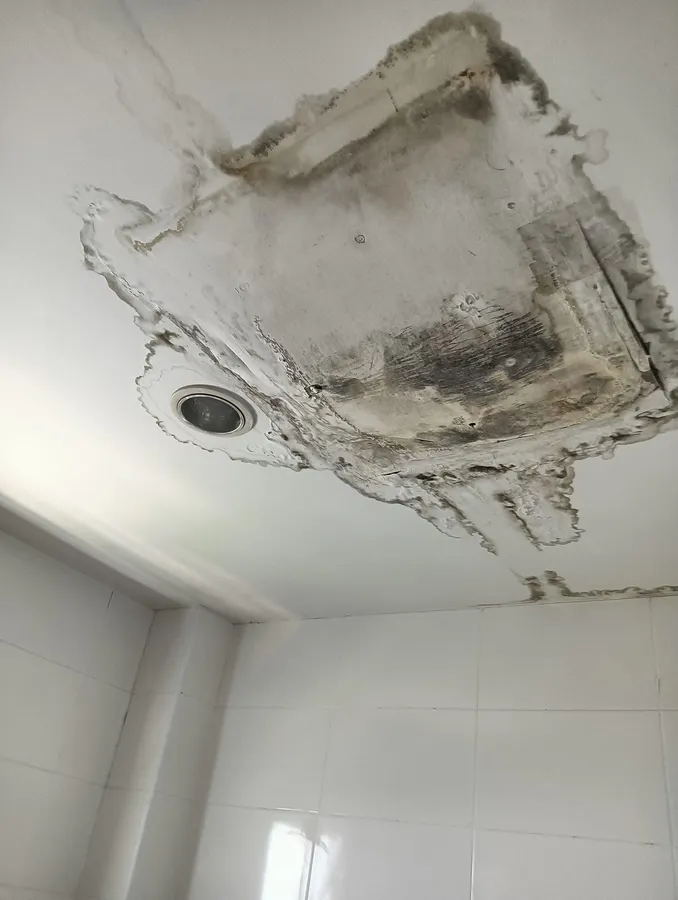
Dripping ceilings, wet spots, peeling paint, and mold — condensation in tropical Thailand is inevitable if the ceiling or air conditioning system is designed without understanding building physics. Let's examine the causes and the most reliable engineering solution.
Condensation in Thai high-rises. Throughout Thailand — from Bangkok to Phuket — the differential between a 65°C rooftop and a 23°C air-conditioned room creates intense condensation. Drops on the ceiling aren't a leak — it's dew point physics. A stretch ceiling collects condensation in a pocket, protecting your furniture.
Thermodynamics of Condensation: Why Does the Ceiling Drip?
Moisture on the ceiling is, in most cases, not a leak from neighbors above. It's pure physics of water vapor partial pressure.
Why Drywall Is the Worst Choice for the Tropics
- Hygroscopic nature: Drywall acts like a sponge. It absorbs condensation from the inter-ceiling space.
- Structural degradation: When wet, gypsum loses strength, becomes heavy and sags, while the paper facing starts delaminating.
- Biological bomb: Damp cellulose (paper facing) at +25°C is an ideal incubator for mold fungi (Aspergillus, Stachybotrys), whose spores you'll be inhaling every night.
Engineering Solution: Hydro and Vapor Barrier via Stretch Membrane
To stop condensation permanently, a comprehensive engineering approach is required — LuxeSpan's dual-contour protection. The PVC membrane alone won't warm up the icy concrete; it will only collect dripping water. The correct protocol: 1. Slab insulation: First, the engineering crew applies closed-cell elastomeric foam to cold areas of the base concrete. This physically shifts the dew point and completely eliminates moisture formation. 2. Vapor barrier shield: The final step is installing a hermetically sealed PVC membrane.
| Effect | How It Works (Physics) |
|---|---|
| ✅ Hydro barrier | In case of critical insulation failure of climate systems or emergency leaks from above, the membrane acts as a safety hydro barrier. The sheet withstands loads up to 100 kg/m², reliably containing water in a closed circuit and protecting the interior until the service crew arrives. |
| ✅ Vapor barrier | The PVC membrane is absolutely moisture-proof. Combined with thermal insulation of the base slab, it functions as a final shield: humid room air physically cannot penetrate the above-ceiling space. |
| ✅ Safety | PVC contains no organics — mold growth on the membrane is biologically impossible. The stretch system works as a sealed shield, permanently separating living space from the damp, problematic base concrete. |
Stop the destruction of your renovation
Hidden condensation destroys finishes. A LuxeSpan engineer will visit your property, perform an instrumental survey, and calculate a quote for slab insulation with subsequent integration of an absolute PVC hydro barrier. You'll get an engineering-grade ceiling under which mold physically cannot form, and in case of a leak from above, water will be reliably contained without damage to the interior.
Free engineering survey: +66 93 520 3970 → [email protected]
Free Survey & Quote
An engineer will visit for a free survey, show you material samples, and calculate the cost for your condo. Result — in just 1 day.
📐 LuxeSpan Engineering Brief
In Thailand, with humidity above 80%, the dew point is reached almost instantly when warm tropical air contacts a cooled surface. If your upstairs neighbor runs their AC continuously, the concrete slab (your ceiling) becomes a cold radiator. Warm, humid air from your unit rises, contacts the cold concrete, and vapor instantly transitions to liquid — condensation forms. The second common cause is ice-cold ductwork pipes in the above-ceiling space.