
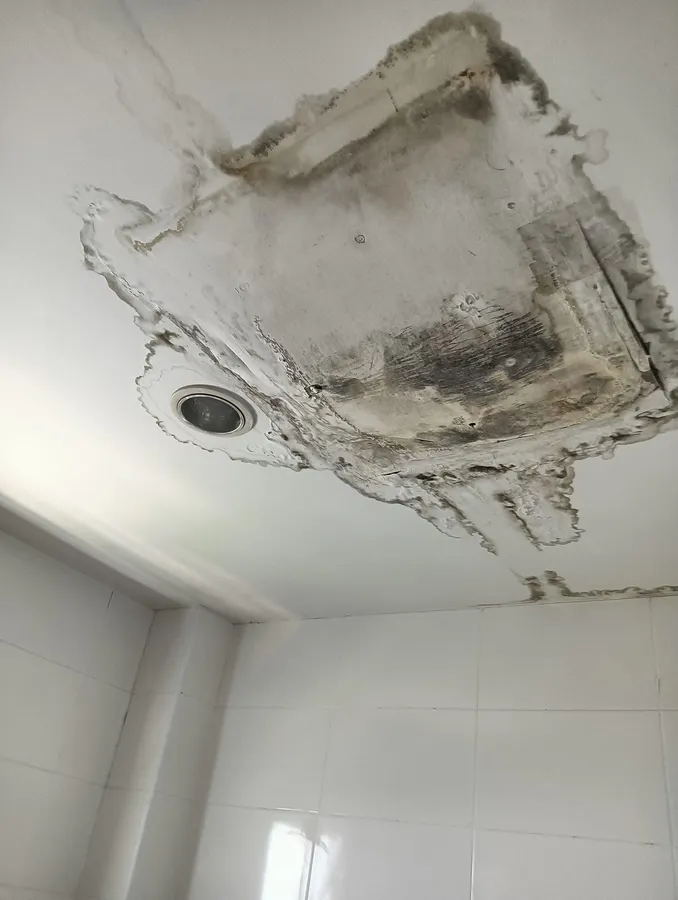
Droplets on the ceiling, damp patches, peeling paint, and mould — condensation in tropical Phuket is inevitable if the ceiling or the air-conditioning system is designed without regard for building physics. Let's examine the causes and the most reliable engineering solution.
Condensation in Phuket — daily occurrence. 2,500mm rainfall + 85–95% humidity = dew point is reached with minimal temperature differentials. In Laguna villas, condensation drips from ceilings even with AC set to 25°C.
The thermodynamics of condensation: why does the ceiling drip?
Moisture on the ceiling is, in most cases, not a leak from the neighbours upstairs. It is pure physics — partial pressure of water vapour.
Why drywall is the worst choice for the tropics
- Hygroscopicity: Drywall acts like a sponge. It absorbs condensation from the ceiling void.
- Structural breakdown: Once wet, gypsum loses strength, gains weight and sags, while the cardboard facing starts to delaminate.
- Biological time bomb: Damp cellulose (cardboard) at +25 °C is the perfect incubator for mould fungi (Aspergillus, Stachybotrys), whose spores you will be inhaling every night.
The engineering solution: hydro- and vapour-barrier stretch membrane
To stop condensation permanently, a comprehensive LuxeSpan engineering approach is required — a dual-barrier system. A PVC membrane alone will not warm the icy concrete; it will merely collect the dripping water. The correct sequence: 1. Slab insulation: First, the engineering crew bonds closed-cell elastomeric foam (synthetic rubber) insulation to the cold areas of the structural concrete. This physically shifts the dew point and completely stops moisture from forming. 2. Vapour-barrier shield: The final stage is the installation of a sealed PVC membrane.
| Effect | How It Works (Physics) |
|---|---|
| ✅ Hydro-barrier | In the event of a critical breach in the climate-system insulation or an emergency leak from upstairs, the membrane acts as a failsafe hydro-barrier. The membrane withstands loads of up to 100 kg/m², reliably containing the water within a sealed perimeter and protecting the interior until a service crew arrives. |
| ✅ Vapour barrier | The PVC membrane is completely moisture-impermeable. Combined with the slab insulation, it works as the final shield: humid room air physically cannot penetrate into the ceiling void. |
| ✅ Safety | PVC contains no organic matter — mould growth on the membrane is biologically impossible. The stretch system functions as a sealed shield, permanently separating the living space from the damp and problematic structural concrete above. |
Stop the destruction of your finish
Hidden condensation destroys interiors. A LuxeSpan engineer will visit your property, carry out an instrument survey of the space, and provide a detailed quote for slab insulation followed by the integration of a sealed PVC hydro-barrier. You'll get a properly engineered ceiling under which mould physically cannot form — and in the event of a leak from upstairs, water will be reliably contained without damage to your interior.
Free engineering survey: +66 93 520 3970 → [email protected]
Tired of stains and mould on your ceiling?
Our engineer will carry out a free survey and provide a quote for membrane installation. The membrane is fitted in just 1 day — no mess, no dust.
📐 LuxeSpan Engineering Brief
in Phuket, at humidity levels of 80%+, the dew point is reached instantly when warm tropical air comes into contact with a chilled surface. If the neighbour upstairs runs their air conditioning non-stop, the concrete slab (your ceiling) becomes a cold radiator. Warm, moist air from your unit rises, meets the cold concrete, and the vapour instantly transitions to liquid — condensation forms. The second common cause is ice-cold ductwork pipes running through the ceiling void.